From-scratch Weight of Evidence / Information Value feature selection and logistic regression, validated line-for-line against scikit-learn on 307,511 real Home Credit applicants, plus an honestly-labeled LightGBM benchmark and its own uncomfortable finding about calibration.
Twenty real, held-out test-set applicants the model never trained on, spanning every risk decile. Each card shows the actual raw application data, the model's real predicted probability of default, and what actually happened. Deliberately includes cases the model got wrong, a scorecard that only shows its wins isn't a scorecard, it's marketing.
Credit scorecards face regulatory and model-risk scrutiny that most ML use cases don't: a rejected applicant can ask why, and "the gradient boosted trees said so" isn't an acceptable answer in most jurisdictions. Weight of Evidence encoding and logistic regression are the industry-standard combination precisely because every coefficient is interpretable and every score decomposes into named reasons. Building both from scratch, validated line-for-line against scikit-learn, was the only way to be sure this project understood the method rather than just calling a library that already does.
8 Home Credit tables joined on SK_ID_CURR: application, bureau, prior applications, POS/cash, credit cards, installments. (src/io_utils.py)
418 columns from anomaly flags, ratios, and per-applicant aggregation of every relational table. (src/feature_engineering_*.py)
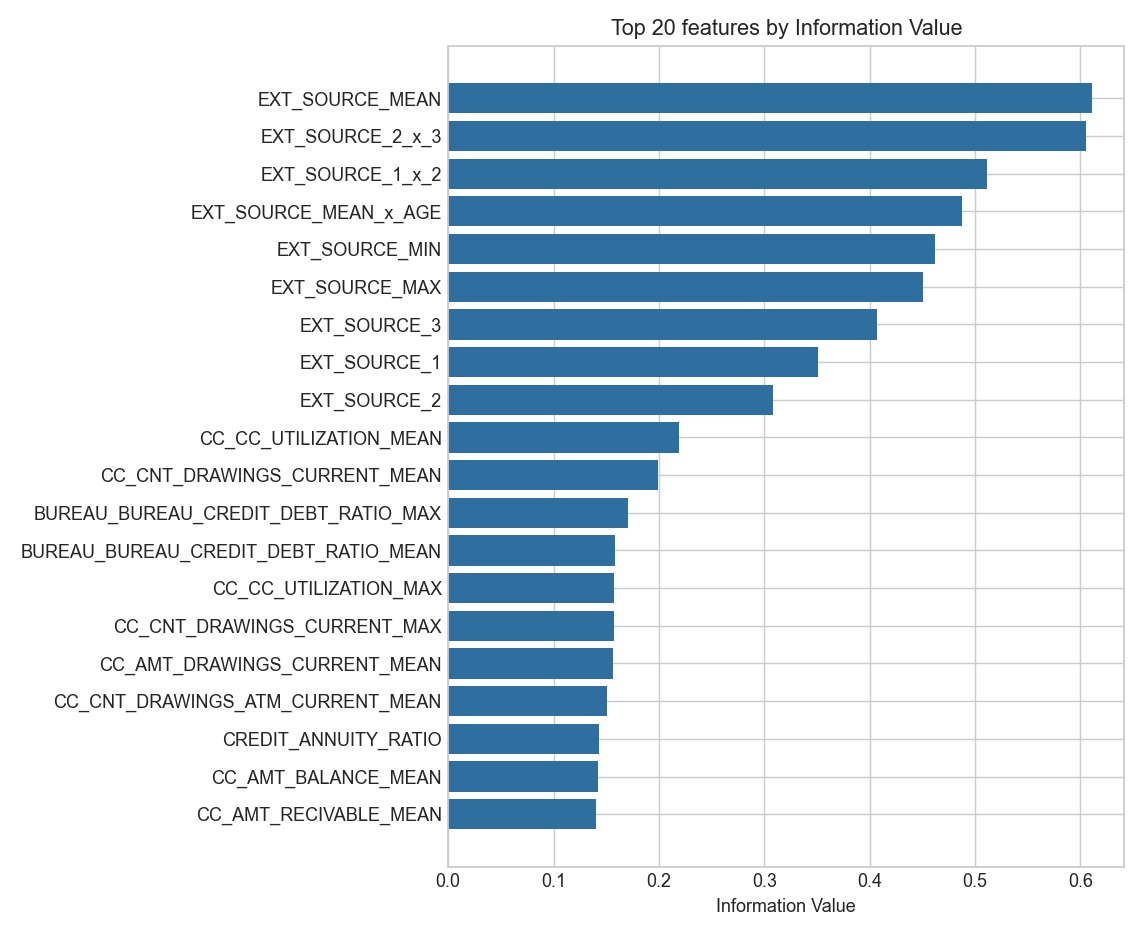
Quantile binning and Information Value from first principles, ranked on the train split only to avoid leakage. Top 80 of 400 numeric features selected. (src/woe_iv.py)
Sigmoid, cross-entropy loss, batch gradient descent, L2 regularization, in NumPy, validated against sklearn on the same data. (src/from_scratch_lr.py)
A library call, honestly labeled as such, to see how much a tree ensemble adds over the linear model.
AUC (rank-sum), GINI, KS, PSI, Brier, calibration, every one validated against scikit-learn to floating-point precision. (src/metrics.py)
These numbers are the real output of run_pipeline.py run end-to-end against the real
Kaggle dataset, re-run and reconfirmed to match to the digit. An earlier version of this project's docs claimed
a from-scratch gradient boosting implementation and a 0.7747 AUC that were never actually built or run, see
README.md and BUILD_STATUS.md for that history.


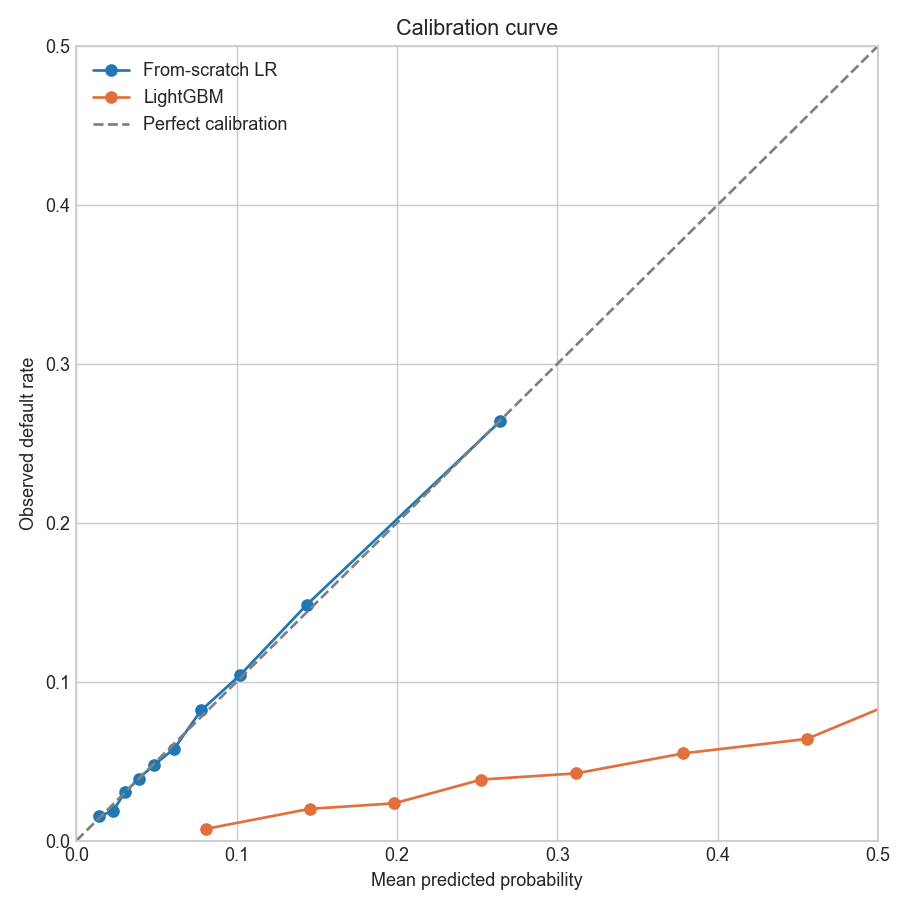
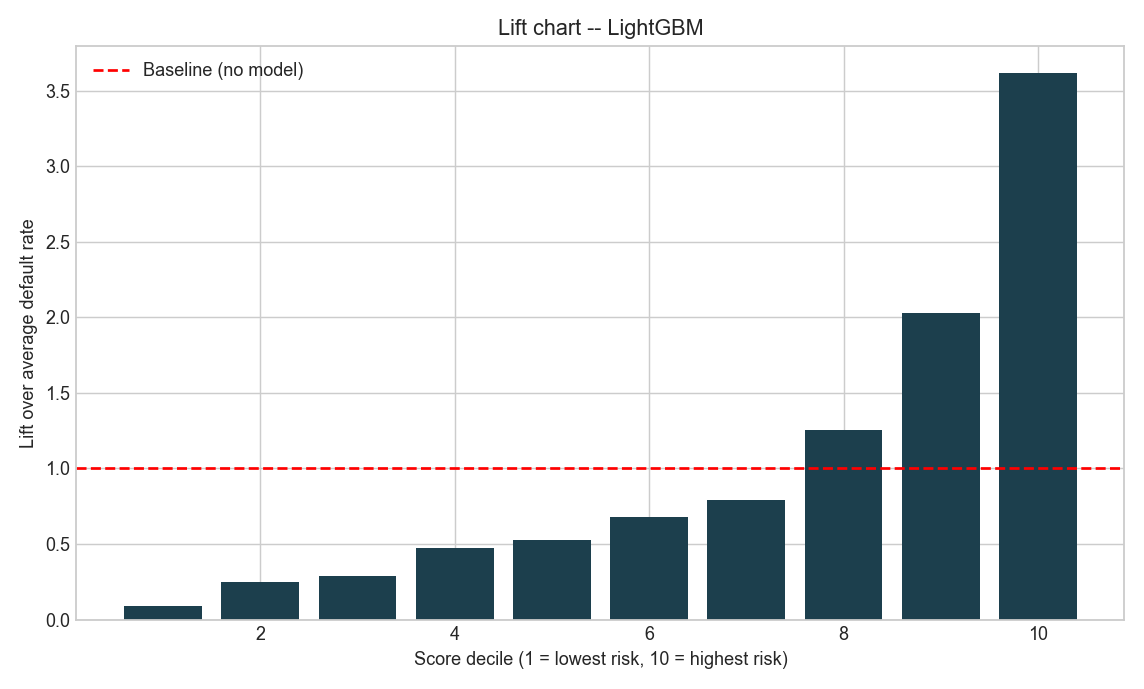
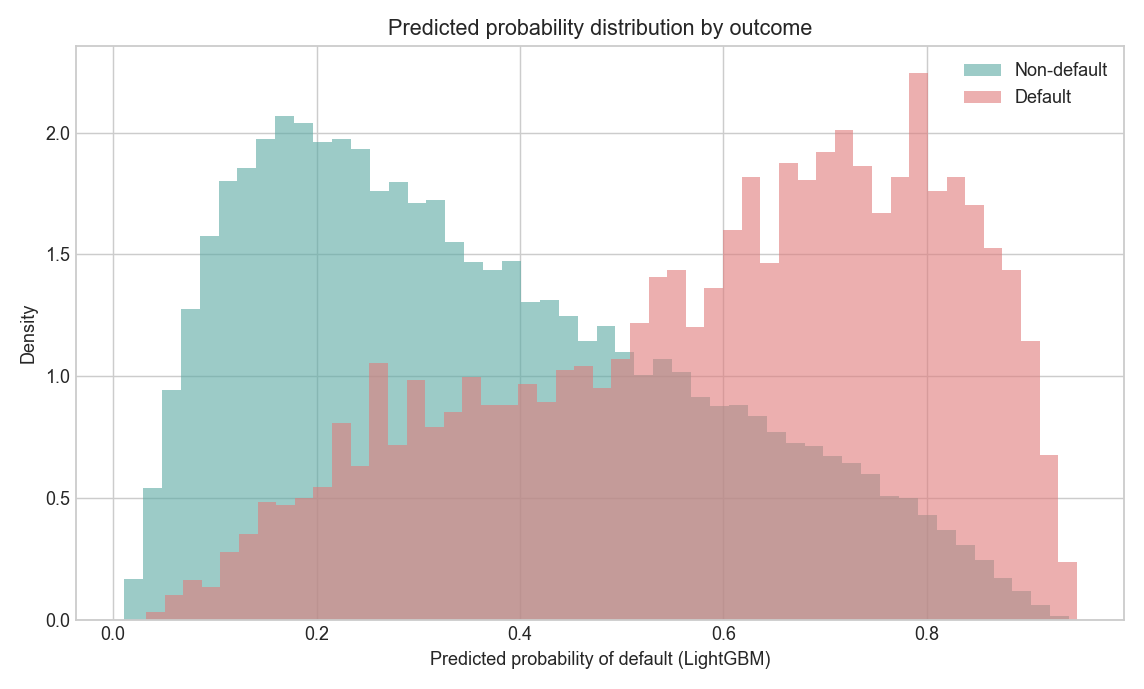
LightGBM wins on discrimination (AUC, GINI, KS all higher than the LR) but its raw output systematically
understates default probability, at a true default rate of ~25% in the highest-risk decile, its mean
predicted probability sits under 10%. It would need isotonic or Platt calibration before feeding an
expected-loss calculation (EL = PD x LGD x EAD) directly.
The from-scratch LR's coefficients differ from sklearn's by up to 0.298 on the full 80-feature set, even though predictions correlate at 0.9985 and AUC matches to 4 decimals. This is multicollinearity among the IV-selected features (several EXT_SOURCE derivatives are near-duplicates by construction), not a bug, on a smaller low-collinearity 10-feature set the max coefficient diff drops to 0.004.
This run uses a random stratified train/val/test split. Home Credit's DAYS_DECISION field would
support a real temporal holdout, which is the harder and more realistic test for a model meant to predict
future defaults. Also unaddressed: the ~18 categorical columns (occupation type, income type, etc.) are
currently dropped rather than encoded.